
Atlas ERP — Intelligent ERP for the Modern Enterprise
One Platform. Every Business Function. Intelligence Everywhere.
Atlas ERP brings the core functions of your enterprise together in one connected platform — combining financial management, sales, procurement, inventory, supply chain, HR, projects, assets, manufacturing, analytics and business intelligence with AI-powered automation and intelligent decision support.
Every Module. One Intelligent Platform.
The Atlas ERP module map — core enterprise functions connected to the Atlas Intelligence layer above them.
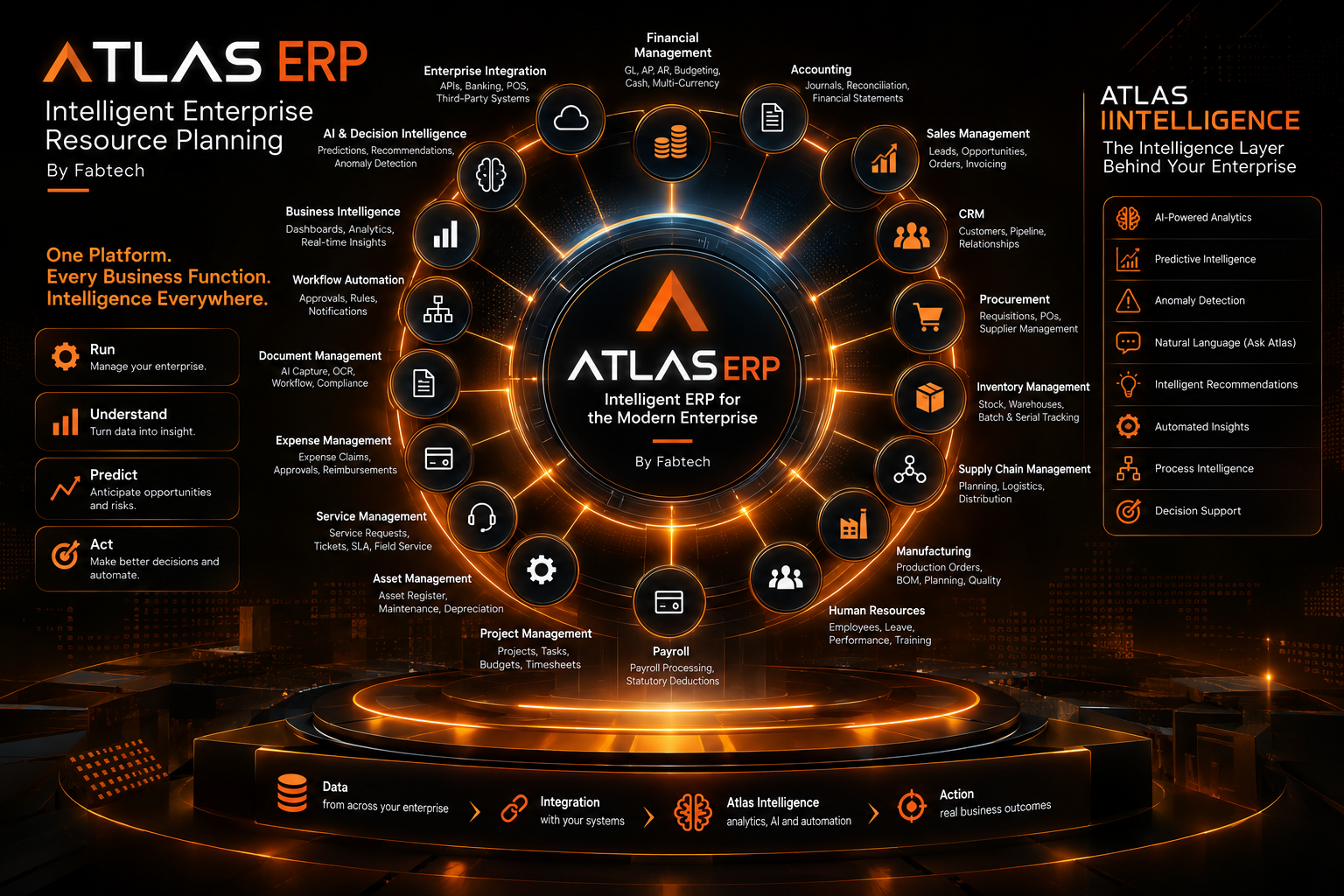
Illustrative platform map — capabilities shown reflect Atlas’s designed architecture; availability may depend on deployment and roadmap stage.
ERP That Does More Than Record Transactions
Traditional ERP systems help organisations record transactions, manage processes and generate reports. Atlas is designed to go further — connecting business functions, data and processes across the enterprise and adding an intelligence layer designed to help organisations understand what is happening, identify important patterns, anticipate potential outcomes and act faster.
Instead of simply answering “What happened?”, Atlas is being designed to help organisations answer: What is happening? Why is it happening? What is likely to happen next? What requires attention? What should we do?
DATA → INFORMATION → INSIGHT → ACTION
One Connected Platform for the Entire Enterprise
Modern organisations often operate across disconnected systems, spreadsheets, applications and databases. Atlas is designed to bring critical business functions together through a unified enterprise platform — creating a connected flow of information across the organisation instead of departments operating in isolation.
Complete Enterprise Resource Planning
Atlas is being designed as a broad enterprise platform covering the core functions organisations need to operate, control and grow their businesses — from finance and sales through to supply chain, people, projects and the intelligence layer that connects them all.
Financial Management
General ledger, payables, receivables, cash, budgets and financial reporting.
Accounting
Core accounting, journals, cost centres and multi-company consolidation.
Expense Management
Submission, approval, policy checks and reimbursement for business expenses.
Sales Management
Leads, quotations, orders, pricing, invoicing and sales performance.
Customer Relationship Management
Connects contacts, opportunities, orders and support into one customer view.
Service Management
Tickets, SLAs, field service and service history for customers and internal teams.
Procurement
Requisitions, RFQs, purchase orders, approvals and spend visibility.
Supplier Management
Supplier records, evaluation, contracts and performance tracking.
Inventory Management
Item master, stock movement, batches, serials and inventory valuation.
Warehouse Management
Bins, picking, packing, dispatch and multi-warehouse operations.
Supply Chain Management
Demand and supply planning, logistics, distribution and fulfilment.
Manufacturing
Bill of materials, production orders, scheduling and quality management.
Human Resources
Employee records, org structure, recruitment, leave and performance.
Payroll
Payroll processing, statutory deductions, benefits and payslips.
Project Management
Planning, tasks, budgets, timesheets, billing and project profitability.
Asset Management
Asset register, assignment, depreciation, maintenance and disposal.
Document Management
Connects ERP transactions with enterprise documents via Papyrus Intelligent EDMS.
Workflow Automation
Rules-based approvals, escalations and automation across every module.
Business Intelligence
Connected dashboards and analytics across the whole enterprise.
Reporting & Analytics
Operational and management reporting drawn from live transactional data.
AI & Decision Intelligence
The intelligence layer — predictions, anomalies and recommendations. See below.
Enterprise Integration
APIs and connectors linking Atlas to banking, POS, CRM and third-party systems.
Financial Management: The Core of Every Atlas Deployment
Financial management gives finance teams a complete view of the organisation’s financial position while connecting financial information directly to operational activity across every other Atlas module.
- General Ledger
- Accounts Payable
- Accounts Receivable
- Cash & Bank Reconciliation
- Multi-Currency, Multi-Company
- Tax & VAT Management
- Cost & Profit Centres
- Budgeting & Forecasting
- Fixed Assets
- Approval Workflows & Audit Trails
Intelligent Finance
Atlas can be designed to use AI and analytics to help finance teams spot what needs attention, including:
- Unusual transactions & duplicate payments
- Expense anomalies & financial leakage
- Cash-flow risks & budget variances
- Revenue trends & margin deterioration
The Intelligence Layer Behind Your Enterprise
Traditional ERP systems record transactions and generate reports. Atlas is designed to add an intelligence layer that continuously analyses authorised enterprise information and helps users understand patterns, identify exceptions, anticipate outcomes and make better-informed decisions.
Run. Understand. Predict. Act.
This is the journey every connected enterprise takes with Atlas — from running daily operations, to understanding what the data means, to anticipating what happens next, to acting on it with confidence.
Run
Manage the enterprise — every core transaction, process and record, in one connected platform.
Understand
Turn enterprise data into insight — one connected view instead of reports scattered across departments.
Predict
Anticipate trends, risks and opportunities before they become a problem on someone’s desk.
Act
Turn insight into action — recommendations, automation and intelligent workflows, with people always in control.
Talk to Your Enterprise Data
Atlas is designed to provide a natural-language interface for authorised users to interact with enterprise information — instead of navigating multiple reports and modules, users can simply ask.
The objective is to make enterprise information accessible without requiring users to become experts in every reporting module.
Predict What Comes Next
Atlas can be designed to support predictive models across key business functions.
Sales Forecasting
Predict future sales from historical and current business patterns.
Demand Forecasting
Predict future demand for products and services.
Cash-Flow Forecasting
Estimate future cash requirements and potential shortfalls.
Customer Churn Prediction
Identify customers showing declining activity or other risk indicators.
Inventory Forecasting
Predict future stock requirements and potential shortages.
Payment Prediction
Identify invoices with patterns associated with delayed payment.
Expense Forecasting
Forecast future expenditure across cost centres.
Workforce Forecasting
Analyse workforce requirements and utilisation.
Project Risk Prediction
Identify early indicators of project delay or cost escalation.
Procurement Forecasting
Identify future purchasing needs from demand and inventory data.
These are capabilities Atlas is designed to support as the product and its data models mature.
Find What Doesn’t Look Right
Atlas can be designed to continuously analyse enterprise activity and identify unusual patterns. The objective is not to generate endless alerts — it is to surface the exceptions that deserve attention.
Turn Reports Into Business Narratives
Traditional dashboards show numbers. Atlas can be designed to help explain what those numbers mean.
Traditional Dashboard
Revenue: KES 42,800,000
Atlas Intelligent Narrative
“Revenue increased compared with the previous period, primarily driven by growth in the wholesale division. However, gross margin declined due to increased procurement costs in several product categories.”
Illustrative example only — not actual Atlas customer data.
Your Enterprise at a Glance
Instead of forcing executives to navigate dozens of reports, Atlas can prioritise the exceptions and insights that matter — built around one question: “What needs my attention?”
Know What Needs Attention
- Revenue below target
- Stock approaching reorder level
- Customer payment overdue
- Budget approaching limit
- Project cost exceeding threshold
- Contract approaching expiry
From Information to Recommendations
Process Intelligence
Analyse business processes to identify bottlenecks, approval delays and inefficient handoffs across procure-to-pay, order-to-cash and other core processes.
What-If Analysis
Explore scenarios such as “What happens if sales increase by 15%?” or “What happens if supplier costs rise by 10%?” before taking action.
AI-Assisted Decision Support
Contextual recommendations that always distinguish data, prediction and recommendation — never presented as confirmed fact.
Connect Documents With Transactions
Atlas can integrate with Fabtech’s Papyrus Intelligent EDMS to connect ERP transactions with enterprise documents — invoices, purchase orders, contracts, delivery notes and more.
Built for Growing, Mobile-First, Multi-Entity Organisations
Your Enterprise, Wherever Work Happens
Atlas is designed with mobile access in mind — approvals, sales, expenses, inventory, field operations, tasks and dashboards, so executives and field teams stay connected wherever they work.
Multi-Company & Multi-Branch
Atlas can be designed to support multiple companies, branches, departments, regions and cost centres, with appropriate access controls and consolidated reporting.
Designed for Cross-Border Operations
Multi-currency transactions, exchange rate management, consolidation and localised, multi-language configuration for organisations operating across borders.
Connect Atlas to the Rest of Your Enterprise
Your ERP should connect your enterprise, not create another silo. Atlas should not become another isolated application.
Enterprise Integration
Banking platforms, payment gateways, mobile money, POS, e-commerce, CRM, HR systems and IoT devices — connected rather than siloed.
API-First Architecture
Open APIs for customers, products, orders, inventory, payments, employees, documents and workflow — so organisations can build an ecosystem around Atlas.
Configurable, Not Rigid
Custom fields, forms, workflows, approval rules, dashboards and roles — so every change doesn’t need to become a custom development project.
Atlas Intelligence Architecture
Enterprise Security & Governance
One Platform. Many Industries.
Banking & Financial Services
Finance, procurement, customer management, reporting.
SACCOs & MFIs
Finance, member management, procurement, HR, assets.
Manufacturing
Production, inventory, procurement, costing, quality.
Retail & Distribution
Sales, POS integration, inventory, purchasing, analytics.
Agriculture
Aggregation, procurement, inventory, payments, traceability.
Healthcare
Finance, procurement, inventory, assets, HR, operations.
NGOs & Development Organisations
Projects, grants, budgets, procurement, reporting.
Professional Services
Projects, timesheets, billing, expenses, CRM.
Government & Public Sector
Finance, procurement, assets, HR, workflows, reporting.
Education
Finance, procurement, assets, HR, reporting.
Atlas at the Centre of the Intelligent Enterprise
Atlas can serve as the core enterprise platform within the wider Fabtech technology ecosystem — one connected enterprise, multiple intelligent capabilities.
From Enterprise Resource Planning to Enterprise Intelligence
Traditional ERP Approach
↓
Process
↓
Report
The Atlas Approach
→ Predict → Recommend
→ Automate → Act
Enterprise Resource Planning → Enterprise Intelligence
What Atlas Is Designed to Help Organisations Achieve
Greater Visibility
Connect enterprise information for a clearer view of operations.
Better Decisions
Timely information, analytics and intelligent insights for decision-makers.
Operational Efficiency
Reduce repetitive manual processes through automation.
Improved Financial Control
Connect operational activity with financial performance.
Inventory Optimisation
Understand demand, stock movement and potential inventory risks.
Faster Processes
Automate approvals and repetitive workflows.
Reduced Information Silos
Connect departments, systems and business processes.
Scalable Operations
A platform designed to evolve with the organisation.
Data-Driven Management
Turn enterprise data into actionable intelligence.
Built for Growing and Complex Enterprises
A Structured Path to Intelligent ERP
Enterprise ERP implementation requires structured planning, not instant deployment.
Discovery
Understand business processes, systems, data and requirements.
Solution Design
Configure the target architecture and business processes.
Data Preparation
Prepare, clean and structure relevant data.
Configuration
Configure Atlas around organisational requirements.
Integration
Connect banking, POS, third-party systems and other platforms.
Testing
Test processes, integrations, security and reporting.
Training
Train users, administrators and management.
Go-Live
Deploy the system using an agreed implementation plan.
Optimisation
Continuously improve workflows, analytics and intelligent capabilities.
More Than Software. A Complete Transformation Partnership.
Atlas ERP is backed by Fabtech’s broader enterprise technology capabilities. Our expertise spans enterprise software, ERP, systems integration, cloud, infrastructure, cybersecurity, data, business intelligence and AI — allowing organisations to approach ERP as part of a broader digital transformation programme rather than an isolated software installation.
Talk to an Atlas ERP ExpertFrequently Asked Questions
What is Atlas ERP?
Atlas ERP is a proprietary enterprise resource planning platform being developed by Fabtech Solutions to bring finance, sales, procurement, inventory, HR, projects, assets, operations, analytics, automation and AI into one connected enterprise platform.
What makes Atlas different from traditional ERP?
Atlas is being designed with an intelligence layer that extends beyond transaction processing and reporting to support AI-assisted insights, predictive analytics, anomaly detection, natural-language interaction, automation and decision support.
Who is Atlas ERP designed for?
Atlas is designed for growing SMEs, mid-market organisations, large enterprises and multi-entity organisations across sectors including manufacturing, retail, distribution, professional services, agriculture, financial services, healthcare, NGOs and public sector organisations.
Does Atlas include financial management?
Financial management is a core part of the Atlas ERP architecture, including capabilities such as general ledger, accounts payable, accounts receivable, budgeting, cash management, financial reporting and related controls.
Does Atlas support inventory management?
Yes. Inventory and warehouse management are core areas of the Atlas platform architecture, with capabilities designed around inventory tracking, warehouses, stock movement, batch and serial management, valuation and inventory analytics.
Can Atlas integrate with other systems?
Atlas is being designed with enterprise integration in mind, including APIs and integration capabilities for banking, payments, POS, e-commerce, document management and other enterprise applications.
Can Atlas use artificial intelligence?
Yes. AI and enterprise intelligence are central to the Atlas product vision, including natural-language interaction, predictive analytics, anomaly detection, intelligent recommendations, automated insights and AI-assisted workflows.
Can Atlas work with Papyrus?
Atlas can be integrated with Fabtech’s Papyrus Intelligent EDMS to connect ERP transactions with enterprise documents, document workflows, OCR, classification and document intelligence.
Can Atlas support multiple companies?
The Atlas architecture is designed to support multi-company, multi-branch and multi-entity organisations, subject to the capabilities implemented in the deployed version.
Is Atlas available now?
Atlas ERP is a proprietary Fabtech platform currently being developed. Availability of individual modules and capabilities will depend on the product release and implementation roadmap.
Can Atlas be customised?
Atlas is being designed with configurable workflows, forms, fields, roles, approvals and business rules so the platform can adapt to different organisational requirements.
Does Fabtech implement Atlas?
Yes. Fabtech’s enterprise technology and ERP implementation capabilities can support discovery, solution design, configuration, integration, data preparation, training, deployment and ongoing optimisation.
Ready to Build a More Intelligent Enterprise?
Atlas ERP brings enterprise resource planning, automation, analytics and AI together in one connected platform. Talk to Fabtech about how Atlas can support your organisation’s next stage of digital transformation.
ATLAS ERP
Intelligent ERP for the Modern Enterprise
RUN → UNDERSTAND → PREDICT → ACT
One Platform. Every Business Function. Intelligence Everywhere.
FABTECH SOLUTIONS · Building Intelligent Enterprises Across Africa · From Infrastructure to Intelligence